
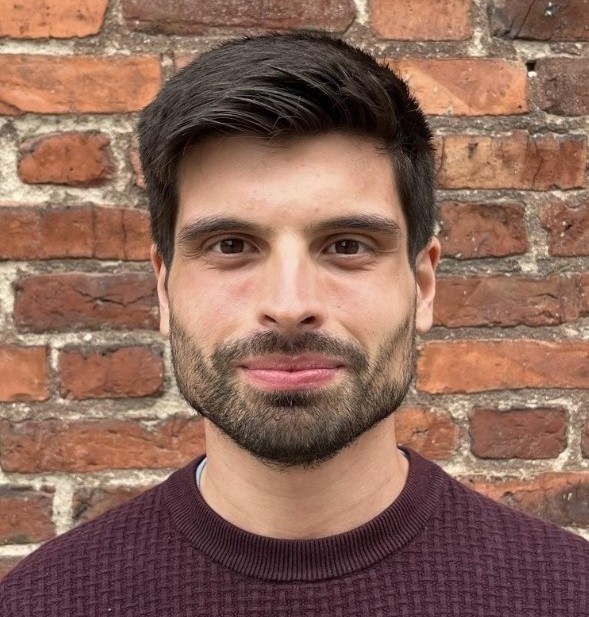
Daniel holds a Bachelor’s degree in Chemistry, with a minor in Biology, from the Faculty of Sciences of the University of Lisbon, where he developed an organometallic ruthenium complex as part of his undergraduate research project.
He subsequently enrolled in the Master’s programme in Chemistry at the same institution. During his Master's studies, his research focused on the development and implementation of electrochemical oxidation methods for the site-selective late-stage deoxyfluorination of alcohols, as well as on the synthesis of hypervalent iodine reagents. This work was carried out under the supervision of Assistant Professor Jaime A. S. Coelho in collaboration with Professor Kevin Lam from the University of Greenwich, where he spent four months as an Erasmus+ student.
In addition to his academic research, Daniel was a member of the team representing Portugal at SensUs, an international student competition focused on the development of an electrochemical biosensor for the continuous monitoring of creatinine levels in human blood. The team was awarded third place for innovation, providing him with valuable experience in interdisciplinary collaboration and the practical application of electrochemical technologies.
His broader scientific interests encompass organic synthesis, organometallic chemistry, electrochemical synthesis, and materials development. In addition, he has experience in peptide synthesis, carbohydrate chemistry, surface modification, and a wide range of analytical techniques.
DC8 will develop robust functional electrocatalytic materials that will enable efficient and selective reductive activation and functionalization of strong polarized σ-bonds with a focus on C-O, C-S and C-F bonds via C-centered radicals. This will provide access to alkyl radicals from unconventional precursor classes opening the door to new retrosynthetic disconnections. The DC will use electrodeposition as an approach to develop a library of novel electrocatalytic materials in systematic iterative processes for energy-efficient transformation of the targeted organic compound classes. The electrocatalysts will be evaluated and the most promising ones will be optimized to enhance their properties. Finally, the electrocatalytic cathodes will be assessed for their performance in desulfurative/deoxygenative/defluorinative bond forming events.
 The Electrify It project has received funding from the European Union’s Horizon Europe research and innovation programme under the Marie Skłodowska-Curie grant agreement No 101226468.